
A Major Challenge for Health Clubs
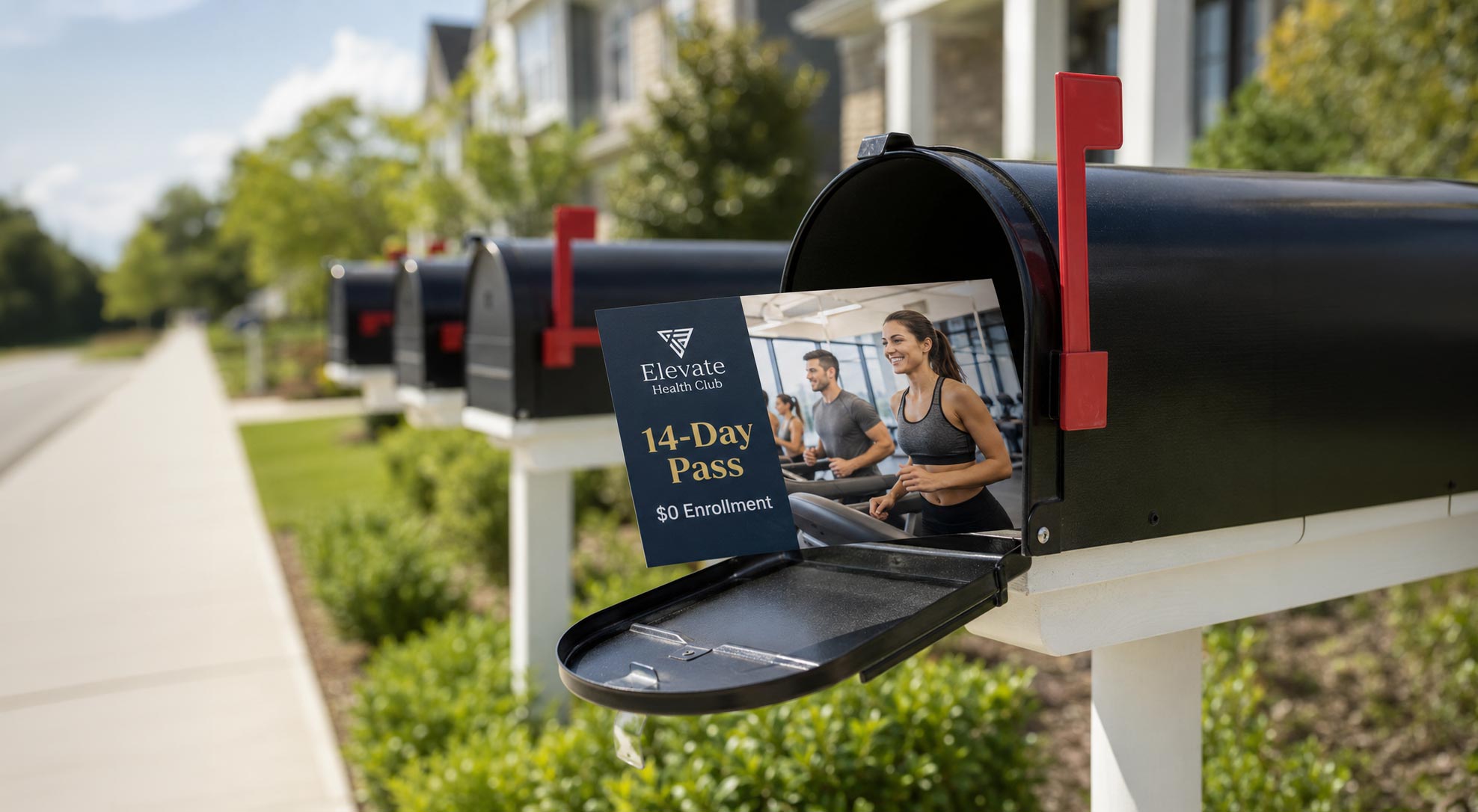
Health club owners have no shortage of ways to place an offer in someone’s mailbox. The real question is whether the offer will get noticed, understood, and acted on.
Coupon book mailers can look appealing because several businesses share the printing and postage expense. Your club receives a small ad alongside restaurants, auto repair shops, carpet cleaners, and other local companies. The upfront price may appear economical.
The problem is that low mailing cost does not always equal low membership acquisition cost.
In our experience at Members Today, a well-planned stand-alone postcard usually gives a health club more control, stronger visibility, and a clearer path from the mailbox to the membership desk. The club is not competing for attention inside the mail piece. The offer, photography, deadline, and call to action all work together to sell one thing: taking the next step toward joining your facility.
That difference matters in a growing but competitive fitness market. The Health & Fitness Association reported that 81 million Americans belonged to a fitness facility in 2025, an all-time high and a 5.2% increase from 2024. More than 100 million people used a fitness facility when visits through guest privileges, day passes, and other arrangements were included. Demand is strong, but every club still has to earn attention in its local market.
A Stand-Alone Postcard Owns the Moment
A coupon book asks the recipient to browse.
A stand-alone postcard asks the recipient to respond.
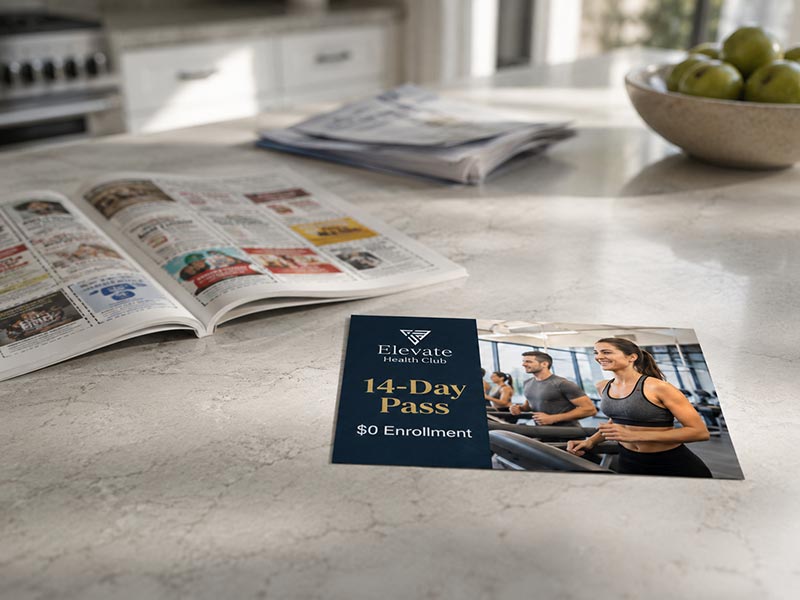
That may sound like a small distinction, but it changes the entire experience. When a homeowner pulls a postcard from the mailbox, the health club’s message is visible immediately. There is no envelope to open, booklet to scan, or page to locate.
The front of the card can feature a welcoming facility image, a relatable member, and one strong headline. The back can explain the offer, establish urgency, and tell the reader exactly what to do next.
A typical campaign might promote:
- $0 enrollment
- A 14-day club pass
- One month free with enrollment
- A discounted family membership
- A transformation challenge
- A free fitness assessment and trial workout
The goal is not to cram six promotions onto one postcard. It is to lead with the offer most likely to create a visit, phone call, QR code scan, or online registration.
That level of focus is difficult to achieve in a coupon book where a club may receive only a fraction of a page.
Coupon Books Divide Attention Among Unrelated Offers
Picture a homeowner flipping through a coupon book after dinner. One page offers $10 off an oil change. Another promotes a pizza special. The next advertises pest control, then a dental cleaning, then a gym membership.
Your health club may have a good offer, but it is surrounded by unrelated buying decisions.
Fitness membership is not usually an impulse purchase in the same way as choosing a restaurant coupon. A prospective member may be thinking about confidence, energy, stress, mobility, weight management, social connection, or getting back into a routine. Those motivations need room to breathe.
A small coupon can display a discount. It has less room to explain why someone should choose your club.
A dedicated postcard can show the facility, introduce the atmosphere, highlight convenient hours, mention childcare or group classes, and remove the fear that often keeps a person from visiting. That is especially important for prospects who feel intimidated by traditional gym advertising.
Better Visibility Does Not Mean More Complicated Design
Some club operators assume a larger format should contain more information. That usually leads to clutter.
The best-performing postcards tend to create a simple visual path:
- Notice the headline.
- Understand the offer.
- Recognize the club.
- See the deadline.
- Take the next step.
A strong mailer might say, “Feel Better This Summer” rather than leading with a list of equipment. The supporting copy can offer a 14-day pass, mention group fitness and personal guidance, and direct the prospect to a short landing page.
The club logo, phone number, address, QR code, URL, and expiration date should be easy to find. Important details should not be buried in a block of tiny text.
This is one area where an experienced Health club direct Direct Mail Service provides value. The job is not limited to printing postcards. It includes offer planning, audience selection, creative development, postal preparation, response tracking, and follow-up strategy.

Targeting Matters More Than Mailing the Cheapest List
Coupon book programs are often distributed across broad areas because the publisher needs enough households to support multiple advertisers. That distribution model may not match a health club’s true service area.
Most clubs draw the majority of their members from a practical drive-time radius. Traffic patterns, major roads, housing density, income, household composition, and nearby competitors can make one carrier route much more valuable than another.
A club may be located five miles from two neighborhoods, yet one neighborhood takes eight minutes to reach while the other requires crossing a congested highway. On a map, the areas look equally close. In practice, they do not have the same membership potential.
At Members Today, campaign planning starts with the club’s market, not an arbitrary mailing quantity. We look at factors such as:
- Existing member address patterns
- Drive time and traffic barriers
- Household age and income ranges
- Homeownership and family composition
- Competing clubs and boutique studios
- New housing development
- Prior campaign performance
- Membership capacity and sales goals
A stand-alone campaign can then be mailed to the households most likely to consider the club. The club is not forced to accept the same distribution footprint used by every restaurant and home service company in a shared mailer.
The Offer Can Match the Club’s Sales Funnel
An effective postcard is not a standalone tactic. It is the first step in a sales process.
For a full-service health club, the postcard may promote a free pass that sends prospects to a dedicated landing page. Once the prospect submits the form, the club should trigger an immediate confirmation email or text message. A membership representative can then call the lead, answer questions, and schedule a visit.
A martial arts studio might use a different path. The postcard could promote a free introductory lesson for children, with the landing page asking for the child’s age and the parent’s preferred class time.
A boutique fitness studio may promote a starter package rather than a free trial. That can help qualify prospects who are willing to make a small commitment before attending.
This is where Health club direct mail Marketing and Health club digital marketing should work together. The postcard creates local awareness and physical visibility. The landing page, retargeting campaign, email sequence, and staff follow-up help convert that attention into an appointment.
Mail should not be treated as a pile of coupons delivered to the front desk. It should be connected to the club’s lead management workflow.
Stand-Alone Mail Makes Tracking More Practical
One common fitness marketing mistake is judging a campaign only by the number of postcards physically brought into the club.
Many prospects see a mailer and respond in another way. They search for the club’s name, visit the website, call the main number, scan a QR code, or stop by without mentioning the postcard.
A properly structured campaign can use several tracking methods:
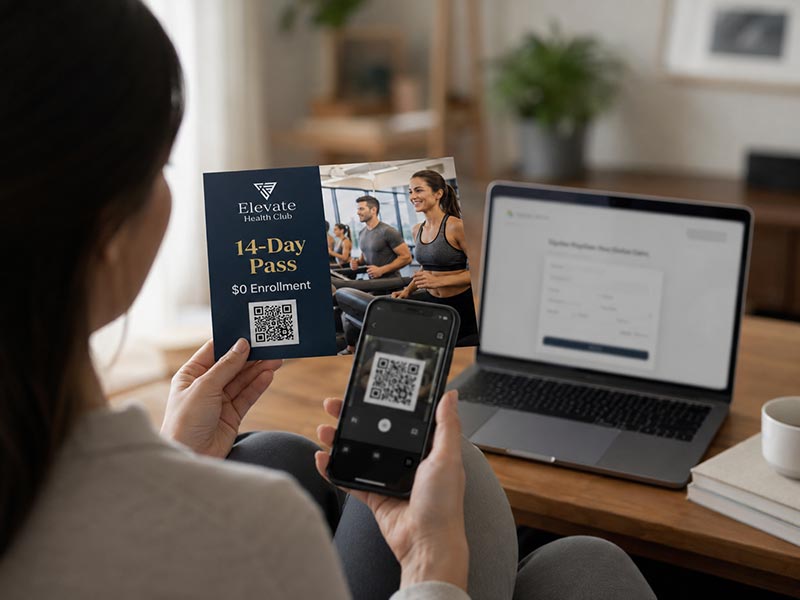
- A campaign-specific QR code
- A short promotional URL
- A unique offer code
- A dedicated phone tracking number
- A campaign field in the club’s CRM
- A source question on the lead form
- A post-campaign address matchback
Online tracking has become a standard part of direct mail measurement. Industry reporting indicates that marketers commonly use QR codes, campaign URLs, coupon codes, CRM activity, and sales matchback to connect mail exposure with response.
Stand-alone postcards make these tools prominent. In a coupon book, a QR code may be reduced to fit a small ad or placed near codes used by other businesses.
Response Rate Is Only One Part of the Calculation
A cheap campaign can produce expensive leads.
Suppose a club spends $1,200 on a coupon book placement and receives 18 inquiries. Six prospects tour the club, and two enroll. The advertising cost per enrollment is $600.
Now suppose the club spends $4,800 on a stand-alone postcard campaign. It produces 120 inquiries, 48 visits, and 20 enrollments. The advertising cost per enrollment is $240.
The second campaign costs more upfront, but it produces members at a much lower acquisition cost.
These figures are only examples. Actual results depend on the market, offer, mailing volume, club reputation, pricing, competition, sales follow-up, and time of year.
The important point is that clubs should evaluate the entire funnel:
Households mailed → responses → qualified leads → appointments → visits → enrollments → collected revenue
Direct mail industry benchmarks can be useful for planning, but they should not replace club-specific tracking. Published reporting based on recent ANA and DMA data has placed prospect-list direct mail response rates around the low single digits, though performance varies widely by audience, format, offer, and industry.
For a health club, the more useful benchmark is often cost per enrollment and collected revenue within 30, 60, or 90 days.
Strong Creative Can Reduce Membership Sales Friction
A postcard begins the sales conversation before the prospect walks through the door.
That means the creative should answer the questions that make people hesitate:
- “Will I fit in?”
- “Is this place only for people who are already in shape?”
- “Will someone show me what to do?”
- “Can I work out before or after work?”
- “Are there programs for beginners?”
A postcard featuring only a highly trained athlete may catch attention, but it can also discourage the very prospect the club needs to reach. Many successful campaigns use approachable imagery and reassuring copy.
For example:
- “Start at Your Own Pace.”
- “Friendly Coaching. Flexible Workouts. Real Support.”
- “Your First Step Is a Simple Club Visit.”
This kind of language does more than promote a discount. It lowers emotional resistance.
Coupon book ads rarely provide enough room to do that well.
The Campaign Can Change With the Season
Health club demand shifts throughout the year. A stand-alone postcard gives the club the flexibility to match the offer to the moment.
A January campaign might promote a guided fresh start rather than a harsh weight-loss message. A spring mailer could focus on energy, movement, and preparing for an active summer. A back-to-school campaign may speak to parents who are ready to rebuild their routines.
The offer should also reflect club operations.
A club with underused small-group training sessions may promote a starter program. A facility opening a new childcare room could target nearby family households. A club with strong senior programming may mail selected neighborhoods with a daytime wellness offer.
This is practical Health club marketing. The campaign is built around the club’s goals, available capacity, target audience, and sales calendar.
A generic coupon book placement cannot usually offer that level of control.

Direct Mail Results Depend on Front-Desk Execution
Even excellent postcards can fail when the club is not prepared for the response.
Before the mail arrives, the staff should know:
- The exact offer and expiration date
- How the promotion is entered into the membership system
- Who receives new leads
- How quickly prospects should be called
- What appointment script to use
- How walk-ins are recorded
- When unresponsive leads receive another follow-up
- How results will be reported
We have seen campaigns generate healthy lead volume while conversions remained weak because calls were delayed, voicemail messages were generic, or front-desk employees did not understand the promotion.
A postcard cannot compensate for a broken sales process.
A practical follow-up sequence might include an immediate text, a call within a few minutes during staffed hours, an email with the pass details, another call the following day, and a deadline reminder before the offer expires.
The mailer creates the opportunity. The sales team still has to care for the lead.
Stand-Alone Postcards Support Long-Term Growth
Coupon book mailers may have a place for certain low-cost, transactional offers. They can create broad exposure, and some clubs may use them as a secondary local advertising channel.
They are rarely the best foundation for a serious membership acquisition campaign.
Stand-alone postcards give health clubs control over the audience, message, offer, timing, design, tracking, and response path. They also give the club enough space to communicate the experience behind the promotion.
That control becomes even more valuable when direct mail is paired with paid search, social advertising, local SEO, email follow-up, and retargeting. The channels reinforce one another instead of operating as isolated promotions.
At Members Today, we build direct mail campaigns around the real economics of health club growth. We look beyond the cost of putting ink on paper. We focus on getting the right offer into the right homes, creating measurable leads, helping the club prepare its sales team, and improving the path from first response to long-term membership.
A postcard should not simply arrive.
It should start a relationship.
FAQ
Most campaigns should begin planning several weeks before the desired in-home date so there is enough time for list selection, design, approvals, printing, and postal preparation
Yes. The campaign can use location-specific versions, URLs, phone numbers, and offers so responses can be attributed to the appropriate facility.
Not always. Showing pricing can help qualify leads, but clubs with several membership options may get better results by promoting a visit, pass, or consultation first.
Yes. Former-member campaigns can be highly effective when the list is clean, the reason for leaving is considered, and the return offer feels more personal than a standard new-member discount.
Frequency depends on market size, budget, seasonality, and prior results. Repetition can improve recognition, but creative and offers should be refreshed so the campaign does not feel stale.
Larger formats often provide better visibility and more room for persuasive creative, but the best size depends on postage, budget, message length, and mailing volume.
It should usually include both, along with an easy-to-type web address. Different prospects prefer different response methods, and every option should lead to the same clearly tracked offer.
Yes. Pre-opening campaigns can build a founding-member list, schedule preview appointments, and create local awareness before the facility begins normal operations.