

In a world where consumers are constantly bombarded with digital advertising, one of the most reliable marketing tools for health clubs continues to be something surprisingly simple: the direct mail postcard.
Every day, potential gym members scroll past sponsored social media posts, delete promotional emails, and skip online advertisements. The sheer volume of digital advertising has made it increasingly difficult for health clubs to capture the attention of local consumers. A professionally designed postcard delivered directly to someone’s home offers a different experience.
Direct mail gives your health club a physical presence in the community. It puts your brand, facilities, and membership offer directly into the hands of prospective members without competing against dozens of other advertisements on the same screen.
At Members Today, we believe that direct mail deserves a prominent place in any well-rounded health club marketing strategy. When you combine intelligent household targeting, compelling membership offers, professional creative design, and digital marketing support, direct mail can become a powerful and profitable source of new memberships.
Direct Mail ROI Remains Strong in a Digital World
The numbers behind direct mail tell an encouraging story. Despite the continued growth of digital advertising, industry research demonstrates that businesses can still generate substantial returns from printed marketing campaigns.
The Association of National Advertisers (ANA), in partnership with Demand Metric, released its 2025 Response Rate Report, which found that direct mail sent to prospect lists generated an average ROI of 67%, up from approximately 34% in its 2023 report. Direct mail ranked just one percentage point behind email to prospect lists, which generated an average ROI of 68%.
Here’s a closer look at some of the reported industry benchmarks.
| Marketing Channel | Average ROI | Report Year |
|---|---|---|
| Direct mail – existing customer lists | 161% | 2023 |
| Direct mail postcards – existing customer lists | 92% | 2021 |
| Direct mail postcards – prospect lists | 85% | 2021 |
| Email – prospect lists | 68% | 2025 |
| Direct mail – prospect lists | 67% | 2025 |
| Social media advertising | 36% | 2025 |
| Direct mail – prospect lists | 34% | 2023 |
Sources: ANA Response Rate Reports and Demand Metric. Figures represent different survey years, mailing formats, and audience types across multiple industries. Results are directional benchmarks, not guaranteed health club campaign results.
What makes these numbers particularly interesting for health club owners is the recurring revenue associated with gym memberships. Unlike a restaurant or retail store that might generate a single transaction from a postcard, a health club can generate monthly revenue from a new customer for several years.
That recurring revenue is one of the biggest reasons health club direct mail has such attractive financial potential.

Why Direct Mail Postcards Work So Well for Health Clubs
Fitness is a local business. Most people aren’t interested in driving 30 minutes across town to exercise three or four times a week. They want a facility that’s convenient, comfortable, affordable, and fits naturally into their daily routine.
Direct mail allows health clubs to concentrate their advertising dollars on the neighborhoods most likely to produce new members. Rather than relying entirely on consumers to search for a gym online, postcards introduce the club to prospective members who may not have started actively looking.
Imagine a family that recently moved into a subdivision two miles from your health club. They’re getting settled, establishing new routines, and exploring local businesses. A postcard featuring your facility, family memberships, childcare services, and an attractive introductory offer could give them a reason to visit.
Without that postcard, they might not even know your club exists.
There is also something valuable about reaching an entire household. A postcard placed on a kitchen counter may be seen by a husband, wife, or another family member over several days. A social media advertisement, on the other hand, may disappear from view within seconds.
For health clubs offering couples memberships, family plans, personal training, group fitness classes, and youth programs, that household exposure creates additional marketing opportunities.
What Does a Successful Direct Mail Postcard Campaign Look Like?
One of the biggest mistakes health club owners make when evaluating direct mail is focusing exclusively on the cost of the mailing. Spending several thousand dollars on printing and postage can seem expensive until you examine the revenue those new memberships could generate.
Consider the following hypothetical campaign for a mid-sized health club looking to increase its membership base.
The club mails 15,000 postcards to carefully selected households within its primary market area. The postcard features professional photography of the facility, a limited-time membership promotion, a QR code, and a clear invitation to visit the club.
Example Health Club Direct Mail Campaign
| Campaign Metric | Results |
|---|---|
| Households mailed | 15,000 |
| Total campaign investment | $9,000 |
| Response rate | 1.5% |
| Membership inquiries | 225 |
| Membership conversion rate | 30% |
| New memberships (rounded) | 68 |
| Cost per lead | $40.00 |
| Cost per new membership | $132.35 |
| Average monthly membership dues | $45 |
| Assumed paid membership duration | 12 months |
| Projected membership revenue | $36,720 |
| Revenue-to-marketing-cost ratio | 4.08:1 |
| Revenue-based marketing ROI | 308% |
This hypothetical campaign is provided for illustrative purposes only. Actual results will vary based on targeting, membership pricing, response rates, sales conversion rates, retention, and campaign expenses. Revenue-based ROI does not account for membership servicing costs.
What initially appeared to be a $9,000 marketing expense has the potential to generate more than $36,000 in membership revenue over the following 12 months.
This example doesn’t include potential revenue from enrollment fees, personal training, premium memberships, retail purchases, or additional family members joining the club. Those additional revenue streams could make each acquired member even more valuable.
It is important to recognize that revenue is not the same as profit. A complete profitability analysis should account for membership cancellations, discounts, servicing costs, sales commissions, and other expenses associated with acquiring and maintaining those memberships.
Even so, the example illustrates why health club owners should evaluate direct mail based on membership acquisition costs and long-term customer value rather than printing and postage costs alone.

Better Targeting Means Better Returns
Mailing more postcards doesn’t automatically produce a better return. Some of the most expensive mistakes in direct mail happen long before the first postcard is printed.
A common approach is to draw a five-mile circle around a health club and mail to every household within that area. While that might seem logical, it doesn’t necessarily reflect where potential members live or how they travel.
A household four miles away with direct highway access might be a better prospect than a household two miles away on the opposite side of a congested intersection. Natural barriers, competing fitness facilities, residential demographics, and commuting patterns all influence membership decisions.
At Members Today, we recommend examining several factors when developing a direct mail strategy:
- Geographic concentration of existing members
- Average drive time to the health club
- Household income and age demographics
- Single-family and multifamily residential areas
- New residential developments
- Competing health club locations
- Historical campaign performance
- Membership pricing and target audiences
Existing membership data can be particularly revealing. If a substantial percentage of your current members come from three specific neighborhoods, it makes sense to examine those communities before spending money reaching households farther away.
Effective fitness direct mail promotions should begin with an understanding of the people most likely to join, not simply the number of postcards a marketing budget can purchase.
A smaller, carefully targeted mailing can sometimes produce better membership acquisition results than a much larger campaign with little regard for household demographics.
Your Membership Offer Can Make or Break the Campaign
A beautifully designed postcard with an uninspiring membership offer is unlikely to deliver exceptional results. Consumers need a reason to act, especially if joining a health club wasn’t already on their immediate to-do list.
The best offer isn’t always the cheapest one. A premium health club that promotes an extremely inexpensive introductory membership may attract prospects whose expectations don’t match the club’s long-term pricing.
Instead, think about the barriers preventing someone from joining. Is it the initial financial commitment? Are they intimidated by unfamiliar equipment? Do they want to experience the facility before making a decision?
Different membership promotions address different concerns.
Some effective direct mail offers worth testing include:
- $0 enrollment or initiation fees
- Complimentary seven-day memberships
- First month free with qualifying enrollment
- Complimentary personal training sessions
- Bring-a-friend fitness passes
- Discounted family membership packages
- Former member reactivation specials
- Limited-time seasonal membership incentives
For a full-service health club, promoting amenities such as swimming pools, childcare, group fitness, recovery services, and modern equipment can be just as important as advertising a discounted membership.
We also recommend keeping the postcard focused on one primary offer. Trying to promote five different membership options, personal training packages, and upcoming events on the same postcard can create unnecessary confusion.
Give prospective members something to get excited about beyond the price, and make it easy for them to take the next step.

Direct Mail and Digital Marketing Are Better Together
The evolution of digital advertising hasn’t made direct mail obsolete. In many ways, it has made direct mail more versatile.
Today’s direct mail postcard can serve as the starting point for a much larger marketing campaign. QR codes, dedicated landing pages, paid search advertising, social media campaigns, and digital remarketing allow health clubs to continue the conversation after a postcard reaches a household.
Consider how a prospective member might interact with a coordinated campaign:
- Direct mail postcard: A prospective member receives a compelling membership offer at home.
- Website visit: They scan the QR code or search for the health club online.
- Digital advertising: They may encounter a Google or social media advertisement reinforcing the same membership promotion.
- Lead generation: The prospect submits an inquiry or claims a complimentary guest pass.
- Membership consultation: The sales team follows up and schedules a club tour.
- New membership: The prospect visits the facility and enrolls.
Each marketing channel serves a different purpose. The postcard introduces the offer, digital advertising reinforces the message, and the sales team converts the interest into a paying membership.
For example, a health club running a January direct mail campaign could simultaneously launch a Google PPC campaign targeting local searches such as “gyms near me” and “health club memberships.” Using the same promotional offer across both channels creates a consistent experience for prospective members.
This coordinated approach to fitness marketing also helps explain why direct mail campaigns are sometimes more effective than traditional response tracking suggests.
A prospective member may receive a postcard on Monday, search for the club on Google on Wednesday, and walk into the facility on Saturday. If the membership consultant records that customer as a Google lead, the postcard may receive no credit for initiating the sale.
The marketing worked. The reporting simply failed to capture the entire customer journey.

Don't Let Poor Sales Follow-Up Destroy Your ROI
There is a difference between generating membership leads and generating memberships. Direct mail can accomplish the first task, but your sales team plays a significant role in accomplishing the second.
Suppose two health clubs run identical campaigns. Both spend $9,000 and generate 225 membership inquiries. The first club converts 15% of those leads into memberships, while the second converts 35%.
The difference in financial performance is substantial.
Same Marketing Budget. Different Sales Results.
| Campaign Metric | Health Club A | Health Club B |
|---|---|---|
| Campaign investment | $9,000 | $9,000 |
| Membership inquiries | 225 | 225 |
| Cost per lead | $40.00 | $40.00 |
| Lead-to-member conversion rate | 15% | 35% |
| New memberships (rounded) | 34 | 79 |
| Cost per new membership | $264.71 | $113.92 |
| Monthly membership dues | $45 | $45 |
| Projected 12-month revenue | $18,360 | $42,660 |
| Revenue-based marketing ROI | 104% | 374% |
In this hypothetical example, Health Club B generates $24,300 more in projected membership revenue without increasing its advertising budget. Calculations assume 12 paid months per new member and exclude membership servicing costs.
Before launching a direct mail campaign, make sure your membership sales team understands the promotion, knows when postcards are expected to arrive, and has a process for responding to inquiries.
Leads should receive prompt follow-up, and membership consultants should focus on scheduling facility visits rather than simply providing pricing information over the phone. Missed appointments should receive follow-up, and expired guest passes should trigger a conversation about membership options.
We encourage health club owners to track the number of leads contacted, appointments scheduled, appointments attended, and memberships sold. These numbers can help identify exactly where potential revenue is being lost.
Sometimes the best way to improve marketing ROI is not to change the marketing. It’s to improve what happens after someone responds.
Consistency Builds Recognition and Membership Growth
Health club owners occasionally abandon direct mail after a single campaign because the immediate results didn’t meet their expectations. The problem with this approach is that consumers don’t necessarily make fitness decisions according to a club’s marketing calendar.
Someone receiving your postcard in September might be interested in joining but unable to commit because of work obligations or family schedules. When another postcard arrives in November, their circumstances may have changed.
Repeated exposure builds familiarity with your brand, particularly in communities where competing health clubs offer similar services.
We recommend developing an annual direct mail calendar around natural opportunities for membership growth. New Year’s resolutions, spring fitness goals, summer memberships, back-to-school routines, fall promotions, and holiday incentives all provide reasons to reconnect with local households.
Consistency doesn’t mean mailing the same postcard every month. Rotate your offers, update your photography, test different headlines, and highlight amenities that are relevant to the season.
The goal is to make your health club one of the first facilities people think about when they’re ready to make a lifestyle change.

Direct Mail Isn't Just for Acquiring New Members
Some of the most overlooked opportunities in health club marketing involve people who already know your business.
Former members, expired guest-pass holders, previous membership inquiries, and inactive customers have an established familiarity with your facility. Reaching these individuals can be more cost-effective than introducing your club to an entirely new audience.
A former member who canceled two years ago because of a demanding work schedule may now be ready to return. A postcard featuring improvements to the facility, new equipment, expanded group fitness schedules, or an exclusive returning-member promotion could provide the encouragement they need.
Current members also present opportunities for growth. Referral postcards, family membership upgrades, personal training promotions, and member appreciation events can generate additional revenue while strengthening existing relationships.
Retention deserves attention, too. A health club that spends considerable money acquiring new members but struggles to retain them will have difficulty achieving a consistently strong marketing ROI. Personalized communications, new-member orientations, fitness consultations, and member appreciation campaigns can help protect the investment made in acquiring those customers.
Maintaining and organizing customer lists should be part of every health club’s long-term marketing strategy. Segmenting audiences allows clubs to develop more relevant offers rather than sending everyone the same generic membership promotion.
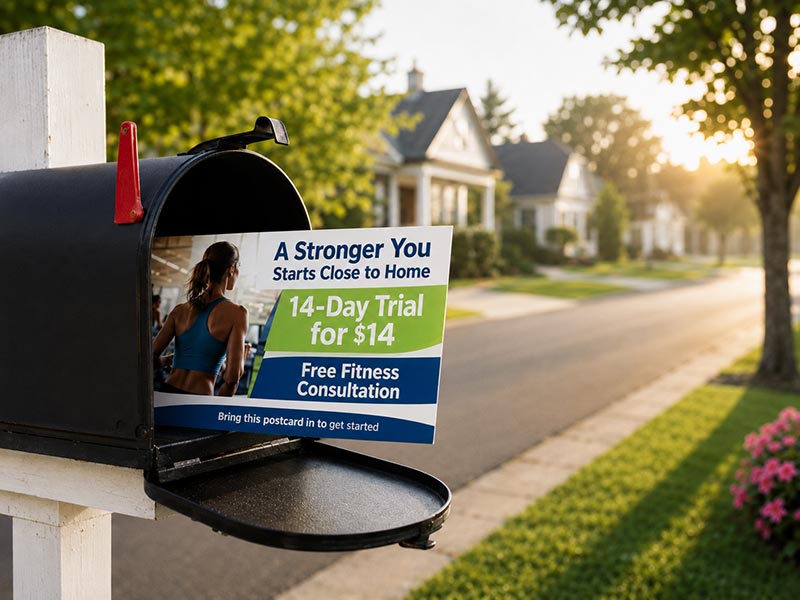
What Could Your Next Direct Mail Campaign Generate?
Every health club has different membership pricing, marketing expenses, sales conversion rates, and membership retention patterns. While industry averages provide a useful reference point, the numbers that matter most are the ones specific to your business.
Before investing in your next direct mail postcard campaign, take some time to understand its potential financial return. How many new members would you need to acquire to recover your marketing investment? What would those memberships generate in revenue over six months, 12 months, or longer?
At Members Today, we’ve made it easier to explore the financial potential of direct mail through our interactive Direct Mail ROI Calculator. It provides a practical way to evaluate different campaign scenarios and establish realistic membership acquisition goals before investing in a mailing.
Whether you’re considering mailing 5,000 postcards to a few select neighborhoods or launching a larger campaign across multiple health club locations, understanding the potential return can help you make a more informed marketing decision.

Get More From Your Health Club Marketing With Members Today
Direct mail has changed considerably over the years. Improved audience targeting, modern printing technology, digital tracking, and integrated advertising strategies have given health clubs more control over how they reach prospective members.
What hasn’t changed is the importance of delivering the right message to the right household at the right time.
At Members Today, we specialize in developing marketing solutions specifically for health clubs, fitness centers, and martial arts studios. Our direct mail services combine strategic household targeting, professional creative design, membership promotions, campaign planning, and mailing services to help clubs attract new members.
We also understand that every fitness facility is different. A luxury athletic club, a neighborhood gym, and a low-cost fitness center require different messaging, different audiences, and different membership acquisition strategies.
Whether you’re preparing for the New Year’s membership rush, opening a new location, experiencing a seasonal slowdown, or simply looking to improve your marketing ROI, a well-planned direct mail postcard campaign deserves serious consideration.
Contact Members Today to learn how we can help your health club generate more membership opportunities, reach more local households, and get a stronger return on your marketing investment.
Frequently Asked Questions About Direct Mail Postcard Marketing
Larger formats, such as 6-by-9-inch or 6-by-11-inch postcards, provide more room for facility photography and membership offers while helping the advertisement stand out. Postage eligibility and mailing costs should also influence the final size.
Ideally, clubs should begin planning three to four weeks before their desired in-home delivery window. Larger campaigns and holiday mailing periods may require additional preparation time.
Yes. Variable designs and targeted mailing lists allow clubs to tailor promotions, imagery, and messaging to different household demographics.
Glossy finishes can enhance colorful facility photography, while matte finishes offer a refined appearance and reduce glare. The best choice depends on the club’s branding, creative design, and production budget.
Including pricing can help qualify prospective members before they respond. Premium health clubs may benefit more from emphasizing amenities, experiences, and complimentary facility visits.
Yes. Multi-location campaigns can use location-specific addresses, QR codes, offers, and mailing lists while maintaining consistent branding across the entire organization.