

Holiday promotions are nothing new in the fitness industry. Most health clubs have run some version of a New Year membership special, summer promotion, Black Friday deal, or “no enrollment fee” offer.
The problem isn’t that gyms aren’t running promotions. It’s that many promotions don’t give people a strong enough reason to act.
We see this often at Members Today. A club creates an offer, puts it on Facebook, sends an email to its database, and waits for memberships to roll in. When response is disappointing, the assumption is that the offer didn’t work.
Sometimes the offer really is the problem. Just as often, though, the club didn’t give the promotion enough reach, urgency, repetition, or follow-up.
Effective health club marketing around a holiday requires more than putting a red, white, and blue border around an ad for Memorial Day. The holiday gives you a reason to communicate with your market. Your offer and marketing strategy still have to do the heavy lifting.
Here’s how we approach holiday promotions for health clubs.
Start With the Reason Someone Should Join Now
Every good promotion needs an answer to one simple question:
Why should I join today instead of next month?
That question matters because most people receiving your advertising aren’t actively shopping for a gym that exact day.
They may have been thinking about getting back in shape. Maybe their current gym is too crowded. Maybe they recently moved into the neighborhood. Maybe they want to lose weight before a vacation.
- Your promotion needs to turn that general interest into action.
- A holiday gives you a natural deadline.
Instead of advertising the same membership price that’s available every day, you might offer a waived enrollment fee through Labor Day weekend, a reduced first month for a New Year’s promotion, or a special membership package available only during your anniversary week.
The offer doesn’t always have to mean giving away membership.
We’ve seen clubs become too aggressive with discounts and accidentally teach prospects to wait for the next deal. If you’re offering $0 enrollment every six weeks, it isn’t really a special anymore.
The strongest offers balance perceived value with actual cost to the club.

Match the Promotion to the Holiday
Not every holiday deserves the same promotion.
New Year’s marketing can lean heavily into fresh starts, routines, and fitness goals because people are already thinking about those things.
Memorial Day and the beginning of summer are different. You might focus on getting ready for summer, having access to an indoor workout during hot weather, family memberships, swimming pools, or group fitness.
Back-to-school season creates another opportunity. Parents are getting back into a routine after summer. That can be a great time to promote morning classes, childcare, personal training, or memberships built around a parent’s schedule.
Black Friday is naturally suited to a harder promotional offer.
Instead of forcing the same “Join Now” message into every holiday, look at what is happening in your prospective member’s life at that particular time.
That’s where fitness marketing becomes much more effective.
Build the Offer Before You Build the Advertising
One of the most common gym marketing mistakes is designing the ad before deciding exactly what the promotion is supposed to accomplish.
Start with the economics.
Let’s say a club normally charges a $79 enrollment fee and $49 per month. Waiving the enrollment fee sounds like a significant $79 discount to the prospect, but the club is primarily giving up one-time revenue while retaining recurring monthly dues.
That may be far more attractive than discounting the monthly membership by $20 indefinitely.
You also need to decide who qualifies.
Is this for new members only? Former members? Couples? Families? Leads already sitting in your CRM?
Then establish a real deadline.
Once those pieces are settled, we can build the health club direct mail, paid search, social advertising, email, landing pages, and follow-up around one consistent offer.
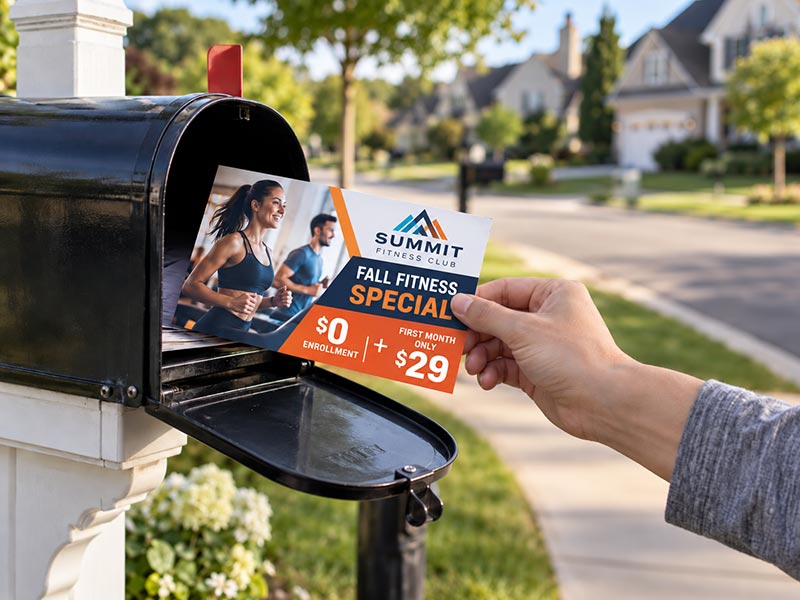
Direct Mail Gives Holiday Promotions Physical Reach
Direct mail remains particularly useful for local health clubs because a gym has a defined geographic market.
You’re not trying to sell memberships to people across the country. You’re trying to reach households within a realistic drive of the club.
That’s why fitness direct mail promotions can play such an important role in a holiday campaign.
Consider a suburban club preparing a Labor Day promotion.
- Instead of simply mailing every household within five miles, we might look at the actual trade area, membership ZIP codes, household density, drive patterns, competing clubs, and the demographics surrounding the location.
- Maybe the strongest opportunity isn’t a perfect five-mile circle. There could be 4,000 households on the other side of a highway that rarely travel toward the club, while a neighborhood six miles away has a direct commuting route past the facility.
Those details matter.
The postcard itself should make the offer easy to understand within seconds. The club name, fitness imagery, primary offer, deadline, location, URL or QR code, and call to action should all be obvious.
A postcard isn’t the place to explain everything about your facility.
Its job is to create enough interest to generate the next action.
Don't Make Direct Mail and Digital Compete
We sometimes hear gym owners ask whether they should spend their marketing budget on direct mail or digital advertising.
For many clubs, that’s the wrong question. These channels can reinforce each other.
Imagine someone receives your Presidents’ Day postcard on Tuesday. They glance at it and put it on the kitchen counter.
- Thursday, they’re searching Google for gyms nearby and see your paid search ad.
- Saturday, they see a social ad promoting the same offer.
Now the club doesn’t feel unfamiliar.
That repeated exposure is valuable. It is one reason we like coordinated campaigns instead of having health club direct mail, PPC, social media, and email operating as separate marketing islands.
The prospect should recognize the same promotion wherever they encounter your club.

Use Paid Search to Capture Existing Demand
Holiday campaigns shouldn’t rely entirely on interrupting people with advertising.
Some prospects are already looking.
Google Ads can help capture people searching terms such as “gym near me,” “health club near me,” “gym membership,” or searches involving your city and surrounding communities.
This is where your fitness digital marketing campaign serves a different purpose from your postcard.
The postcard can create demand.
Search advertising captures demand that already exists.
Your holiday offer can make the search ad more compelling, but don’t bury the basic reason someone searched in the first place. Someone searching for a gym still needs to understand where you are, what you offer, and why your facility fits their needs.
Watch cost per lead closely, but don’t evaluate campaigns on CPL alone.
A campaign generating 40 leads at $25 each isn’t automatically better than one generating 25 leads at $35 each. If the second group produces twice as many memberships, those more expensive leads were considerably more valuable.
Track the lead all the way to membership.

Give Every Promotion Its Own Landing Experience
Sending holiday advertising to the regular homepage is usually a missed opportunity.
Your prospect clicked because of a specific promotion.
Continue that conversation.
If the ad says:
Labor Day Membership Special — Join by September 7 and Pay No Enrollment Fee
the landing page should immediately confirm that offer.
Don’t make someone search through navigation menus to figure out how to claim it.
A useful campaign landing page can include the offer, deadline, a few important club benefits, facility photos, location information, a short lead form, and a clear call to action.
Keep the form reasonable.
- If someone is responding to a membership offer, you probably don’t need twelve fields before your sales team can contact them.
- Name, email, phone number, and perhaps a simple membership-interest question may be enough to start the conversation.
Organic Search Still Matters During Promotional Campaigns
Not every person who sees your campaign will click the advertisement.
People research.
Someone may receive a postcard and search your club name later that evening. Another person may see a social ad and then search “best gym in [city].”
That makes fitness SEO and local search visibility part of the larger campaign.
Your Google Business Profile should be accurate. Your website should clearly communicate your location, services, amenities, and membership options. Local pages should answer the kinds of questions prospective members actually search.
Reviews matter here too.
A strong offer might get someone interested, but a poor online presence can make that interest disappear quickly.
Marketing doesn’t stop when someone notices the promotion.

Your Follow-Up Speed Can Make or Break the Campaign
This is one of the least glamorous parts of a holiday campaign, and one of the most important.
What happens when the leads arrive?
We’ve seen clubs invest thousands of dollars generating leads and then wait until the next day to contact them.
That’s a sales problem disguised as a marketing problem.
When someone requests information, schedule a tour, claims an offer, or asks about membership, your team should have a defined follow-up process.
For example, the prospect completes the form. They receive an immediate confirmation text or email. A membership representative calls promptly. If there’s no answer, the prospect enters a follow-up sequence using calls, text messages, and email.
The goal is to move from:
Ad → Lead → Conversation → Visit → Membership
Every stage needs attention.
If your campaign generates 100 leads and only 25 receive meaningful follow-up, changing the Facebook headline probably isn’t going to fix your membership numbers.

Train Your Front Desk Before the Promotion Starts
This is another practical detail that gets overlooked.
If you’re mailing 20,000 postcards and running digital ads for a Presidents’ Day promotion, everyone answering the phone should know about it.
- Give the staff the postcard.
- Show them the digital ads.
- Explain who qualifies, when the offer expires, and what happens when someone asks about it after the deadline.
Your membership team should also know what information you’re tracking.
“How did you hear about us?” isn’t enough.
Was it the postcard? Google? Facebook? Instagram? An email? A referral?
Attribution will never be perfect, especially with multiple channels working together, but better tracking helps you make smarter decisions about the next campaign.
Create Urgency Without Manufacturing It
Holiday campaigns work partly because they have natural expiration dates.
Use them.
If your Black Friday promotion ends November 30, say so.
As the deadline approaches, your messaging can become more urgent:
- “Four Days Left.”
- “Ends Sunday.”
- “Final Weekend.”
This works especially well with email, SMS, retargeting, and social media because messaging can change quickly as the promotion progresses.
What we don’t recommend is fake urgency.
If your “48-hour special” mysteriously runs for another three weeks, prospects learn that your deadlines don’t mean anything.
A real deadline makes the decision easier.
Don't Forget Your Existing Members
Holiday marketing isn’t only about acquiring new memberships.
It can also create referral and retention opportunities.
Consider giving current members a holiday guest pass, referral incentive, or opportunity to bring a friend to a class.
The economics can be attractive.
Your existing member already knows the facility. They know your staff. They can explain what they like about the club in a way an advertisement can’t.
A referred prospect also walks through the door with a built-in connection.
That doesn’t mean every referral needs a large cash reward. Clubs can test account credits, merchandise, personal-training sessions, guest privileges, or other benefits that fit the membership model.
The holiday simply gives you a reason to ask.

Judge the Promotion by Memberships, Not Leads
Lead volume gets attention because it’s easy to measure. Membership revenue matters more.
- Let’s say Campaign A spends $3,000 and generates 120 leads. That’s a $25 cost per lead.
- Campaign B spends the same amount and generates only 80 leads, giving you a $37.50 cost per lead.
At first glance, Campaign A looks better.
But suppose Campaign A produces 12 memberships while Campaign B produces 20.
The story changes completely.
Campaign A’s acquisition cost is $250 per membership. Campaign B’s is $150.
This is why Members Today encourages clubs to connect advertising data with actual sales results whenever possible.
- Cost per lead tells you something.
- Cost per membership tells you much more.

Build a Holiday Marketing Calendar Instead of Starting From Scratch
The best time to plan your Memorial Day campaign isn’t the week before Memorial Day.
Build an annual promotional calendar.
Identify the major periods when your club has historically seen membership opportunities. These could include New Year’s, Presidents’ Day, spring, Memorial Day, summer, back-to-school, Labor Day, Black Friday, and year-end promotions.
You don’t need a giant discount for every event.
Some periods may warrant a major acquisition campaign. Others can focus on referrals, personal training, former-member reactivation, or lead nurturing.
- Planning early also gives you enough time to coordinate creative, mailing lists, printing, postage, landing pages, PPC campaigns, social ads, email, and staff training.
- That coordination is where a campaign starts feeling like one campaign instead of six unrelated marketing activities.
Turn One Promotion Into Information for the Next
Every campaign should teach you something.
- Which ZIP codes produced memberships?
- Which offer generated the most appointments?
- What was the cost per lead from paid search?
- How many postcard respondents joined?
- Which landing page converted best?
- How many leads scheduled tours but never showed?
- How many tours became memberships?
Those numbers help us improve the next campaign.
Over time, health club marketing becomes less about guessing which promotion might work and more about building on what you’ve learned about your market.
That’s particularly important as marketing becomes more automated and AI tools become more common. AI can help with research, creative variations, campaign analysis, ad optimization, and follow-up workflows.
It still can’t replace understanding your club’s actual market.
Your best data comes from your own members: where they live, why they joined, which offers motivated them, what channels introduced them to the club, and what ultimately convinced them to sign the membership agreement.
Make Your Next Holiday Promotion Work Harder
A holiday isn’t a marketing strategy.
It’s an opportunity to give your market a timely reason to pay attention.
At Members Today, we help health clubs connect the pieces of a campaign instead of treating them as separate projects. That can include health club direct mail, fitness direct mail promotions, paid digital advertising, local targeting, fitness SEO, campaign strategy, and the systems needed to turn responses into membership opportunities.
The clubs that tend to get more from holiday promotions aren’t necessarily the ones offering the biggest discount.
They’re the ones with a clear offer, smart targeting, enough reach, consistent messaging, fast lead follow-up, and a sales process ready to convert interest into memberships.
That’s what turns a holiday special into a membership acquisition campaign.
FAQ
Not necessarily. Different locations can have different competition, demographics, membership pricing, and capacity, so an offer that works well at one club may need adjustment at another.
Yes. Former-member reactivation campaigns can be especially effective when the club has made improvements, added equipment, introduced classes, or created a compelling reason to return.
It depends on the club’s sales strategy and offer. Showing pricing can prequalify prospects, while withholding it may encourage more conversations with the membership team.
Build onboarding into the campaign. Getting new members into classes, assessments, personal training introductions, or structured workout routines can help them develop an early connection with the club.
Usually, yes. Someone who sees an offline or digital promotion should be able to visit the website and quickly confirm that the offer is legitimate and still available.
Yes. Personal training packages, assessments, small-group training, and introductory coaching programs can all be promoted independently or bundled with a membership campaign.
Don’t discard them. Leads who didn’t join can enter a longer-term nurture campaign and may respond to a future offer, club event, guest pass, or membership follow-up.
Yes. Pre-opening campaigns can build a founding-member list, schedule preview appointments, and create local awareness before the facility begins normal operations.