Health club marketing has changed a lot over the last few years, but the goal has not changed at all.
You still need real people in your community to notice your club, trust your offer, visit your facility, and become paying members. The difference now is how many steps happen before they ever speak with your front desk team.
A prospective member may see your direct mail postcard at home, search your club on Google, read reviews, ask an AI tool for “best gyms near me,” compare your offer to three competitors, visit your website, watch a short video, and then fill out a lead form at 10:47 p.m.
That is the new buying path.
At Members Today, we work with health clubs, gyms, fitness centers, and martial arts studios that need more than random ads. They need a marketing system that connects direct mail, digital ads, local SEO, landing pages, lead follow-up, and member retention. In the AI digital age, the clubs that win are not always the clubs with the biggest budget. They are the clubs with the clearest message, the strongest local presence, and the fastest follow-up.
Table of Contents
AI Did Not Replace Local Trust
AI has changed how people search, but it has not replaced trust.
When someone searches for a health club, they still care about location, price, equipment, cleanliness, hours, classes, childcare, parking, staff, and whether the club feels right for them. AI may help organize that information, but it cannot create trust out of thin air.
That means your health club marketing needs to make your value easy to understand everywhere your prospects look.
Your website should clearly answer basic questions. Your Google Business Profile should be accurate. Your reviews should be current. Your offers should be simple. Your direct mail should match your digital ads. Your sales team should know exactly what promotion is running and what to say when a new lead calls.
We see this problem all the time. A club runs a strong fitness direct mail promotion, but the landing page shows a different offer. The Facebook ad says “Join for $1,” the front desk says “I’m not sure if that is still active,” and the Google listing has old holiday hours. That kind of broken experience makes people hesitate.
In the AI age, confusion is expensive.

Start With a Clear Membership Offer
A strong campaign starts with a clear offer.
For health clubs, vague messages like “Get in shape today” or “Join our fitness family” do not usually create urgency. They may sound nice, but they do not give the prospect a reason to act now.
A better offer is specific.
For example:
“Join by June 30 and pay $0 enrollment.”
“Get 14 days free with a local guest pass.”
“Founders rate available for the first 100 new members.”
“Bring this postcard in for a free fitness assessment.”
These offers give people a next step. They also give your team something concrete to track.
A health club direct mail campaign works best when the offer is easy to read in three seconds. The same rule applies to PPC ads, landing pages, email campaigns, and text follow-up. A busy parent, a former member, or a local professional does not want to decode your promotion. They want to know what they get, how much it costs, and what to do next.
Use Direct Mail to Own the Local Market
Health club direct mail still works because fitness is local.
Most people do not join a gym 35 minutes away unless it offers something highly specialized. They join close to home, close to work, or close to their child’s school. That makes direct mail one of the most useful ways to reach the households that actually matter.
With fitness direct mail promotions, we often recommend targeting around drive time, household income, age, family makeup, and past customer data when available. A family-focused club may target neighborhoods with young households and promote childcare, youth fitness, aquatics, or family memberships. A high-end training studio may focus on higher-income households and lead with coaching, accountability, and transformation.
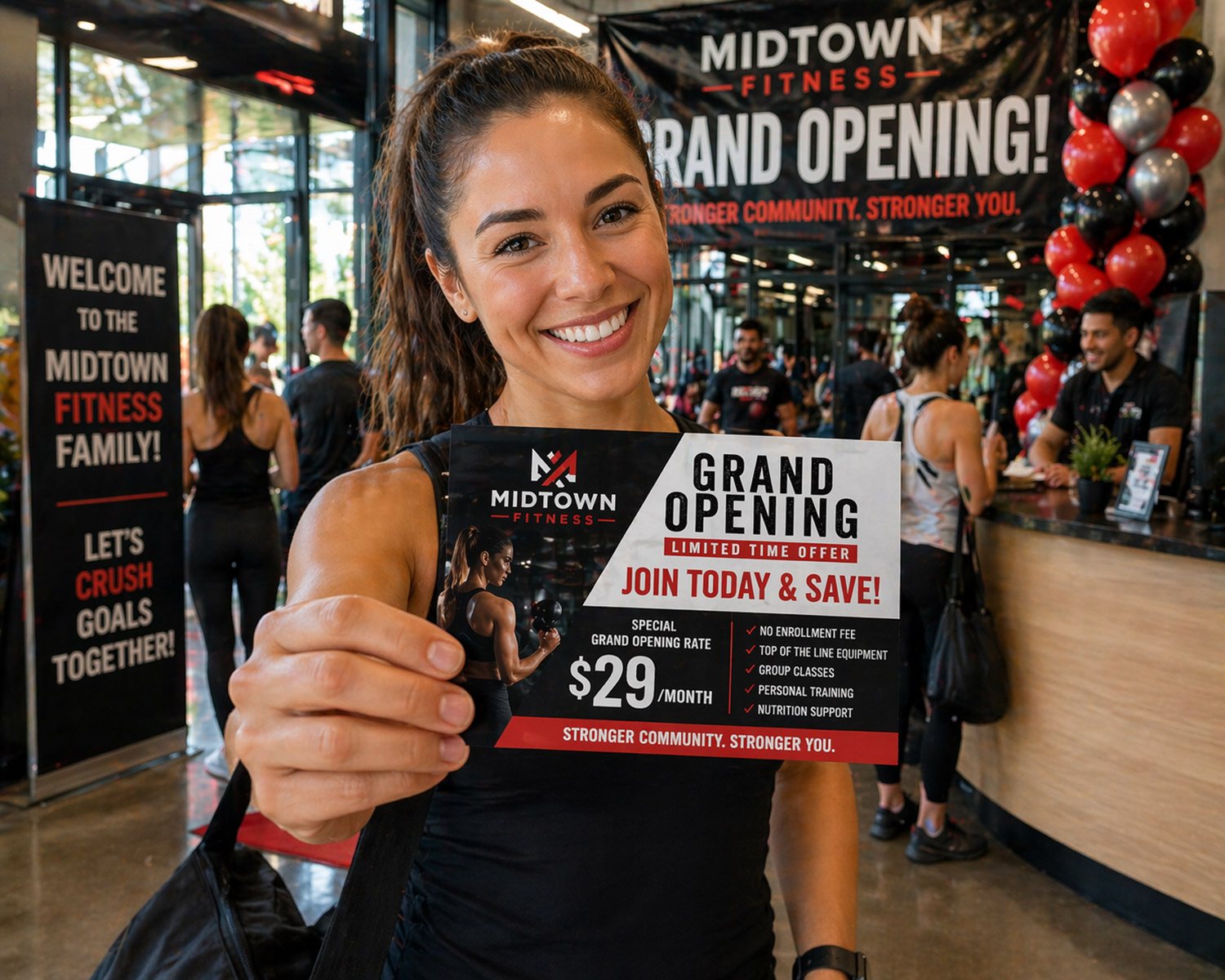
Direct mail also gives your club a physical touchpoint in a digital-heavy world.
A postcard on a kitchen counter can get seen by a spouse, parent, teenager, or roommate. It can sit on the fridge until the person is ready. It can be handed to the front desk. It can include a QR code, call tracking number, map, deadline, and offer code.
A strong postcard usually includes:
- A bold headline
- A simple offer
- A strong image
- A clear deadline
- A local map or location cue
- A QR code or URL
- A phone number
- A short reason to trust the club
The mistake is trying to say everything. A postcard is not a brochure. It is a door opener.
Match Direct Mail With Digital Ads
Direct mail gets stronger when it is paired with fitness digital marketing.
A household may receive a postcard on Monday, see a Google ad on Tuesday, get a Facebook or Instagram ad on Wednesday, and search your club name on Thursday. Each touchpoint makes the next one feel more familiar.
This is where many clubs miss easy wins. They treat direct mail and digital ads as separate campaigns. The postcard has one design. The landing page has another message. The PPC ad has a different offer. The social ad sends traffic to the homepage.
That weakens the campaign.
When Members Today builds a campaign, we like to keep the message tight across every channel. If the direct mail offer is “$0 Enrollment Through July 15,” the PPC ad should say the same thing. The landing page should repeat it. The follow-up email should reference it. The front desk script should include it.
Consistency helps prospects feel safe. It also helps your team convert leads because they are not explaining five different promotions at once.

Build Landing Pages That Convert
Your homepage is not always the best place to send paid traffic.
A good health club marketing campaign needs focused landing pages. The page should match the offer and remove distractions. It should show the visitor what they need to know to take action.
For example, a summer membership campaign landing page might include:
- A headline that repeats the offer
- A short paragraph about who the club is for
- Photos of the actual facility
- A simple lead form
- A phone number
- A few reviews
- A list of key amenities
- A deadline
- A map
- A strong call to action
Do not make people hunt for the offer. Do not bury the form. Do not lead with a giant block of text about your club history.
People are often comparing options. They may be nervous about cost, contracts, crowds, or feeling out of place. A good landing page reduces that friction.
The lead form should be short. Name, phone, email, and area of interest are often enough. Once the lead comes in, speed matters. A lead that gets called within a few minutes is much more valuable than one that sits until tomorrow afternoon.
Use Fitness SEO to Become the Local Answer
Fitness SEO is not just about ranking for “gym near me.”
It is about helping search engines, AI tools, and real people understand why your club is a good choice in your market.
Your website should have strong pages for your core services and amenities. That may include personal training, group fitness, weight loss programs, youth fitness, senior fitness, aquatics, pickleball, childcare, sauna, recovery, or local corporate wellness.
Each page should answer real questions.
Who is this for?
What does it include?
How does it work?
What makes your club different?
What should a new member expect?
How do they get started?

Local SEO also matters. Your Google Business Profile should have updated photos, correct hours, accurate categories, service descriptions, and steady review activity. Photos of real equipment, real staff, and real spaces beat generic stock images almost every time.
The AI digital age rewards clear, helpful, organized information. Thin pages with generic copy are easier to ignore. Useful pages that sound like they were written by people who understand the fitness business are harder to replace.
Stop Chasing Every New AI Tool
AI tools can help your marketing, but they are not a strategy by themselves.
A club owner can use AI to brainstorm email subject lines, organize blog topics, summarize survey feedback, or outline ad variations. That can save time. The risk comes when the club lets AI write everything with no local insight.
Generic AI content sounds smooth, but it often misses the little details that make a club feel real.
It may not mention your 5 a.m. bootcamp crowd. It may not understand that your January leads are different from your August leads. It may not know that your childcare room is a major selling point for young families. It may not know that your best members come from three neighborhoods around a certain school district.
Use AI as a tool. Do not let it flatten your brand.
The best health club marketing still comes from knowing the market, the members, the staff, the offer, and the common objections. AI can help move faster, but your local experience is the edge.

Most struggling campaigns do not fail because the club has a bad facility. They fail because the gym marketing system has gaps.
Here are common mistakes we see:
- Running ads without a clear offer
- Sending traffic to a weak homepage
- Using stock photos instead of real club images
- Not tracking calls from direct mail
- Letting leads sit too long
- Running too many promotions at once
- Ignoring former members
- Using old reviews and outdated photos
- Stopping campaigns too early
- Judging direct mail only by QR scans
- Not training the front desk on the campaign

That last one is huge.
Your marketing can create interest, but your team has to convert it. If someone walks in with a postcard, the front desk should know the offer, the deadline, the tour process, and the close. If someone calls from a PPC ad, the team should know how to book a visit instead of simply listing prices.
A good campaign includes sales support. Scripts, lead sheets, call tracking, offer codes, and front desk reminders can make a big difference.
Cost per lead matters, but it does not tell the whole story.
A $12 lead that never answers the phone is not better than a $45 lead that books a tour and joins. A cheap lead from a broad giveaway may look good in a report, but it may waste staff time. A more expensive lead from a strong local search campaign may convert at a much higher rate.
Health club marketing should be measured through the full funnel.
That means tracking:
- Campaign spend
- Leads generated
- Calls received
- Appointments booked
- Tours completed
- Memberships sold
- Average membership value
- Retention after 30, 60, and 90 days
- Referrals created

Digging Deeper:
For example, a direct mail campaign may generate fewer form fills than a digital campaign, but the people who bring in the postcard may be more serious. PPC may generate strong intent from people searching “gym membership near me,” but costs can rise in competitive markets. Social ads may build awareness, but they often need good follow-up to convert.
The point is not to pick one channel forever. The point is to understand how each channel supports the sale.
Build a Simple Sales Funnel
A strong sales funnel does not need to be complicated.
Here is a practical example for a health club:
- Step 1: A household receives a postcard with a 14-day guest pass.
- Step 2: The same household sees a matching Facebook ad.
- Step 3: A family member scans the QR code and lands on a campaign page.
- Step 4: They fill out a short form.
- Step 5: The club sends an instant text and email.
- Step 6: A staff member calls within minutes to book a tour.
- Step 7: The prospect visits the club and receives a simple membership presentation.
- Step 8: If they do not join, they enter a 7-day follow-up sequence.
- Step 9: If they join, they receive a new member onboarding sequence.
- Step 10: After 30 days, they are asked for a review or referral.
That is a real system.
Many clubs stop at step four. They generate leads, then hope people show up. Hope is not a funnel.

Turn New Members Into Long-Term Members
Marketing does not end when someone joins.
The first 30 days are critical. New members are still deciding if they made the right choice. They need to feel seen, welcomed, and guided.
A simple onboarding system can improve retention. Send a welcome email. Invite them to a fitness assessment. Show them how to book classes. Introduce them to staff. Give them a simple workout path. Check in after the first week.
Retention also supports acquisition. Happy members leave reviews, bring friends, post on social media, and respond to referral offers.
Referral campaigns work well when they feel easy and timely. For example:
“Bring a friend this month and you both get a free personal training session.”
“Refer a new member and receive a club credit.”
“Invite a guest to Member Appreciation Week.”
These campaigns work best when the team promotes them in person, not just by email. Put the message at the front desk. Add it to member texts. Mention it after classes. Print small referral cards. The more visible it is, the more likely members are to act.

Create Content That Sounds Like Your Club
Health club marketing in the AI digital age needs human texture.
Your content should sound like it came from people who know the facility. Talk about what members ask during tours. Talk about how beginners feel on day one. Talk about why your trainers coach the way they do. Talk about the difference between a packed January rush and a steady fall routine.
This is the kind of content that helps with fitness SEO because it answers real questions. It also helps with conversion because prospects feel understood.
Strong content topics may include:
What to expect during your first gym tour
How to choose the right membership
Beginner-friendly group fitness classes
How personal training helps new members stay consistent
Why local families choose your health club
How to restart fitness after a long break
Best times to visit the gym if you dislike crowds
What makes your club different from a big-box gym
These articles do not need to be stuffed with keywords. They need to be useful, local, and specific.
Keep Your Marketing Calendar Grounded
Health clubs have natural campaign windows.
January is obvious, but it is not the only opportunity. Spring, summer, back-to-school, fall reset, holiday gift promotions, Black Friday, and New Year presale campaigns can all work. The key is planning early.
A strong annual calendar may include:
January New Year membership campaign
March spring fitness reset
May summer shape-up campaign
August back-to-school family membership campaign
October fall wellness campaign
November Black Friday offer
December New Year presale campaign
Each campaign can include health club direct mail, email, PPC, social ads, landing pages, in-club signage, and referral pushes. You do not need every channel every time, but you do need a coordinated plan.
Waiting until the week before a promotion usually leads to rushed creative, weak offers, and poor follow-up.
How Members Today Helps Health Clubs Grow
Members Today helps health clubs build marketing campaigns that are clear, local, and built for membership growth.
We understand how fitness marketing works at the club level. A campaign is not just an ad. It has to fit the sales process, the offer, the staff, the market, and the season. A beautiful postcard does not help if the call tracking is missing. A strong PPC campaign falls short if the landing page is weak. A good lead gets wasted if nobody follows up.
Our work can include health club direct mail, fitness direct mail promotions, fitness digital marketing, PPC campaigns, fitness SEO, local SEO, campaign landing pages, and marketing strategy. The goal is not to make noise. The goal is to help your club attract the right people and turn more of them into members.
In the AI digital age, the clubs that grow will be the ones that combine smart technology with real local marketing. They will use AI where it helps, but they will not lose their voice. They will track leads, but they will still care about people. They will show up in search, mailboxes, inboxes, social feeds, and local conversations.
That is where strong health club marketing wins.

FAQ
A health club can use AI to organize ideas, draft outlines, review campaign data, and speed up content planning, but final messaging should still include real local details and staff insight.
Yes. Health club direct mail is still useful because gym membership decisions are local, and a well-targeted postcard can reach nearby households with a clear offer.
The best channel depends on your market, offer, and sales process. Most clubs perform better when direct mail, PPC, SEO, email, and social ads work together.
Most health clubs should plan several seasonal campaigns per year, including New Year, spring, summer, back-to-school, fall, and holiday promotions.
A strong fitness direct mail promotion needs a clear offer, bold design, accurate targeting, a deadline, call tracking, and a front desk team that knows how to convert responses.
Local SEO helps your club appear when people search for gyms, fitness centers, classes, and training options near them. It also supports trust through reviews, photos, and accurate business information.
Not always. A focused landing page usually works better for paid campaigns because it matches the offer and makes the next step easier.
Fast follow-up, simple appointment booking, strong tour scripts, clear pricing conversations, and consistent nurture messages can all improve lead conversion.